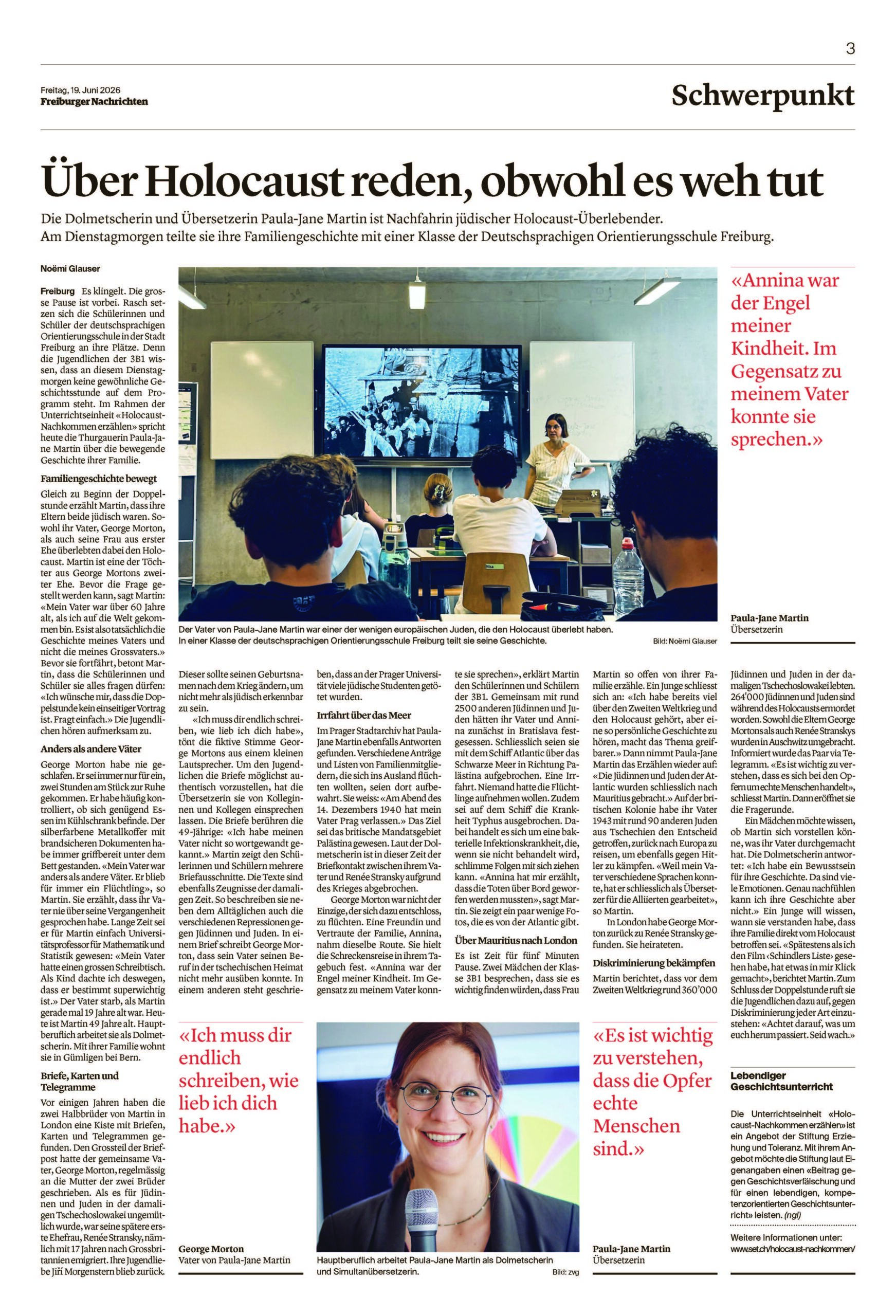
The bell rings. The long break is over. The pupils at
the German-speaking secondary school in the city of Freiburg quickly take their seats. The pupils in class 3B1 know that this Tuesday morning’s history lesson is no ordinary one. As part of the teaching unit ‘Holocaust Survivors’ Descendants Tell Their Stories’, Paula-Jane Martin from Thurgau is speaking today about her family’s moving history.
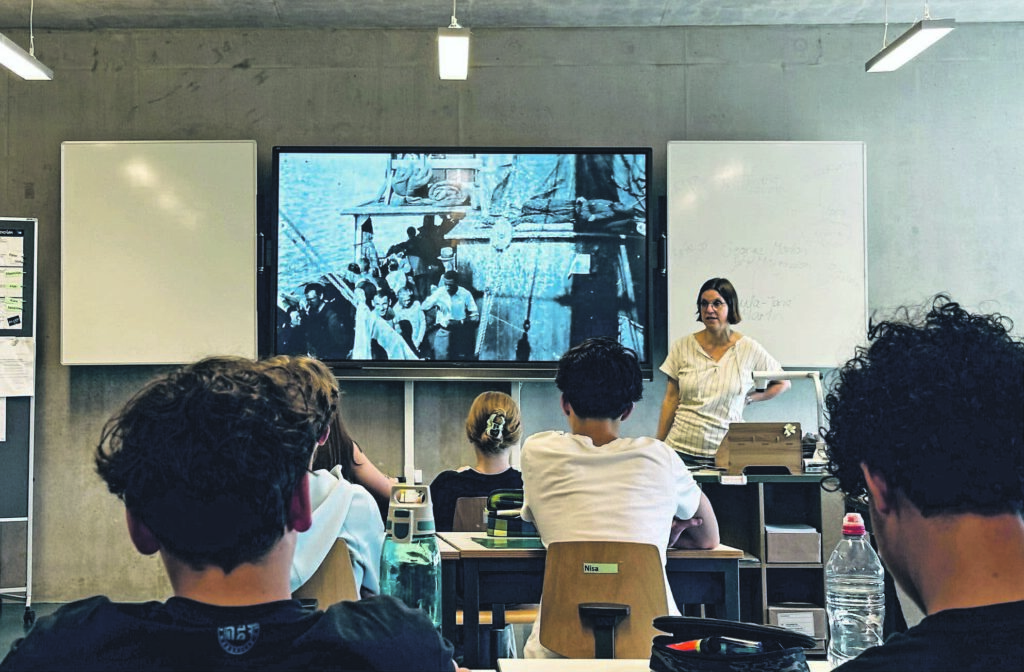
Right at the start of the double lesson, Martin explains that both her parents were Jewish. Both her father, George Morton, and his wife from his first marriage survived the Holocaust. Martin is one of the daughters from George Morton’s second marriage. Before anyone has a chance to ask, Martin says:
“My father was over 60 when I was born. So it’s actually my father’s story, not my grandfather’s.” Before she continues, Martin emphasises that the pupils are free to ask her anything:
‘I’d like this double lesson not to be a one-way lecture. Just ask questions.’ The young people are listening attentively.
George Morton never slept. He would only ever rest for an hour or two at a time. He frequently checked to see if there was enough food in the fridge. The silver-coloured metal briefcase containing fireproof documents was always kept within easy reach under the bed.
‘My father was different from other fathers. He remained a refugee for the rest of his life,’ said Martin.
She explains that her father never spoke about his past. For a long time, to Martin, he was simply a university professor of mathematics and statistics: “My father had a huge desk. As a child, I thought that must mean he was really important.” Her father died when Martin was just 19 years old. Today, Martin is 49 years old. Her main job is as an interpreter. She lives with her family in Gümligen, near Bern.
A few years ago, Martin’s two half-brothers found a box of letters, cards and telegrams in London. Most of the letters had been written regularly by their shared father, George Morton, to the two brothers’ mother. When conditions for Jews in what was then Czechoslovakia became difficult, his future first wife, Renée Stransky, had emigrated to the UK at the age of 17. Her childhood sweetheart, Jiří Morgenstern, stayed behind. After the war, he would change his birth name so as not to be recognisable as Jewish. ‘I must finally write to you to tell you how much I love you,’ says George Morton’s fictional voice from a small loudspeaker. To present the letters to the young people as authentically as possible, the translator had them read aloud by colleagues.
The letters move the 49-year-old: “I didn’t know my father to be so eloquent.” Martin shows the pupils several excerpts from the letters. The texts also serve as records of that era. As well as describing everyday life, they recount the various forms of repression against Jewish people. In one letter, George Morton writes that his father could no longer practise his profession in his native Czech homeland. Another states that many Jewish students were killed at Prague University.
Paula-Jane Martin also found answers in the Prague City Archives. Various applications and lists of family members who wanted to flee abroad are kept there. She knows: “On the evening of 14 December 1940, my father left Prague.” The destination was the British Mandate of Palestine. According to the interpreter, correspondence between her father and Renée Stransky ceased during this period due to the war. George Morton was not the only one who decided to flee.
A friend and close confidante of the family, Annina, took the same route. She recorded the harrowing journey in her diary.
“Annina was the angel of my childhood. Unlike my father, she could speak,” Martin explains to the pupils of class 3B1. Together with around 2,500 other Jews, his father and Annina had initially been stranded in Bratislava. Eventually, they set sail on the ship Atlantic across the Black Sea towards Palestine. An odyssey. No one had been willing to take the refugees in. What’s more, an outbreak of typhus had occurred on the ship. This is a bacterial infectious disease which, if left untreated, can have serious consequences. ‘Annina told me that the dead had to be thrown overboard,’ says Martin. She shows a few of the few photographs that exist of the Atlantic.
It’s time for a five-minute break. Two girls from Class 3B1 are discussing how they think it’s important that Ms Martin talks so openly about her family. A boy agrees: “I’ve already heard a lot about the Second World War and the Holocaust, but hearing such a personal story makes the subject feel more real.” Then Paula-Jane Martin resumes her story:
“The Jewish people from the Atlantic were eventually taken to Mauritius.” In the British colony, her father, along with around 90 other Jews from the Czech Republic, decided in 1943 to return to Europe to fight against Hitler as well. “Because my father spoke several languages, he eventually worked as a translator for the Allies,” says Martin. In London, George Morton was reunited with Renée Stransky. They got married.
© 2023 PJ Martin (CHE-470.730.672) | General Sales Conditions | Impressum | Disclaimer | Cookie Policy


